Post Jobs
“People in a modern Quebec City office meeting room discussing and collaborating around a table under natural light.”

What Is Quebec’s Professional Culture (and How Does It Work)?

Quebec’s culture is a distinct blend of French heritage, North American values, and modern workplace practices that shapes how people communicate, collaborate, and build professional relationships. Unlike the rest of Canada, Quebec operates primarily in French, follows unique labor laws, and maintains social customs rooted in centuries of tradition. For anyone seeking employment in Quebec City, understanding these cultural foundations isn’t just helpful, it’s essential for successful integration into the workplace.
Key Takeaway: Quebec’s professional culture combines formal French-language expectations with egalitarian work relationships and strong protections for employee rights, creating a workplace environment that values both tradition and …


“Work permit documents and a graduation cap beside an open laptop on a café table with a blurred Canadian city background, symbolizing study options while holding a work permit.”

Can Work Permit Holders Study in Canada? Your Rights and Options in 2026

Yes, you can study in Canada while holding a work permit. As of September 4, 2026, a temporary public policy allows eligible foreign workers to enroll in short-term educational programs without needing a separate study permit, as long as the course lasts six months or less and your work permit remains valid.
This change opens doors for work permit holders across Canada who want to upgrade their skills, explore new career paths, or take advantage of remote job opportunities that require specific training. If you’ve been considering taking a professional course, learning French to integrate better into Quebec City’s workplace culture, or earning a certificate that could advance your career, you now have more flexibility than ever before.
The…

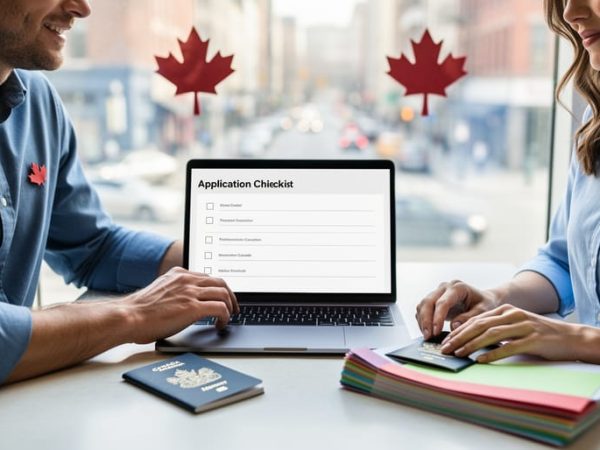
A Canadian couple reviewing immigration documents at a table with a laptop, passport, and organized folders, suggesting preparation for a spousal open work permit application.

Spousal Open Work Permit Processing Time: What to Expect in 2026

If you’re applying for a spousal open work permit in Canada, the current processing time is approximately 9 weeks. This timeline applies when you’re a spouse or common-law partner being sponsored for permanent residence and already living in Canada with an Acknowledgement of Receipt (AOR) confirming your application is in process.
Understanding this timeframe helps you plan your finances, career moves, and daily life during what can feel like an uncertain waiting period. The 9-week estimate gives you a realistic window to prepare for employment, but actual processing times can vary based on application volume and individual circumstances.
A spousal open work permit offers valuable flexibility. Unlike employer-specific work permits, this document allows you to work for any Canadian employer in almost any position, giving you freedom to build your career in …

A customer service representative wearing a headset at a phone support desk in a call-center environment, representing immigration and employment phone support in Canada.

1-800 Immigration Number: How to Contact Canadian Employment and Immigration Support

Finding the right immigration phone number can save you hours of confusion and get you the answers you need today. For most immigration and work and immigration questions in Canada, dial 1-800-622-6232 (1-800-O-Canada). This toll-free service connects you Monday through Friday, 8 am to 5 pm your local time, with staff who can answer questions about work permits, Employment Insurance, and general immigration support. If you’re an employer hiring in Quebec City or asking about the Temporary Foreign Worker Program, call the Employer Contact Centre at 1-800-367-5693 instead. They’re available for automated services 24/7, with live support weekdays from 7 am to 8 pm Eastern Time.
Knowing which number to call matters. The wrong line means longer wait times and …

Business traveler holding a passport and documents in a modern airport, symbolizing an L-1 intracompany transfer to the United States.

L-1 Visa: Transfer to the U.S. with Your Current Employer

The L-1 visa lets multinational companies transfer employees from their foreign offices to U.S. locations, or send managers and executives to establish a new U.S. branch. If you’ve worked for your current employer abroad for at least one continuous year within the past three years and you’re moving to the United States in an executive, managerial, or specialized knowledge role, you may qualify for this visa category.
Two versions exist: the L-1A for executives and managers, and the L-1B for employees with specialized knowledge. The L-1A classification is particularly valuable because it enables foreign companies without an existing U.S. presence to send a leader stateside specifically to build that operation from the ground up.
Your employer takes the lead in this process. They must file Form I-129, Petition for a Nonimmigrant Worker, on your behalf with U.S…

Canadian and Australian professionals handshake in an office with a desk showing a passport and folder, representing employer-sponsored work visa pathways.

How to Apply for an Australian Work Visa as a Canadian: Employer Sponsorship Routes Explained

Working in Australia from Canada requires employer sponsorship through one of two main pathways: a temporary 482 visa that can transition to permanent residency, or direct permanent entry via the 186 visa. Both routes involve a two-stage process where an Australian employer first nominates you, then you submit your visa application. The process is straightforward once you understand which pathway fits your situation and what your prospective employer needs to do on your end.
Key Takeaway: The 482 Temporary Skill Shortage visa lets you work in Australia temporarily and transition to permanent residency after two years with the same employer, while the 186 visa grants permanent residency immediately through either direct entry or after holding a 482. Both require nomination by an approved Australian sponsor.
The employer-sponsored …

Immigration-related paperwork and a passport on a desk in front of a U.S. government building entrance with an American flag.

US Citizenship and Immigration Services Employment: How USCIS Hiring Works and What Job Seekers Need to Know

US Citizenship and Immigration Services (USCIS) employment refers to two distinct pathways: career opportunities within the federal agency itself, and the employment authorization documents and processes USCIS administers for foreign workers seeking to build their lives in the United States. If you’re exploring career paths at USCIS, you’ll find positions ranging from immigration officers to administrative roles that support the agency’s mission. If you need work authorization in the U.S., USCIS processes Employment Authorization Documents (EADs), green card applications, and temporary work visas that determine your ability to earn income legally.
Understanding how work and immigration systems function across North America helps you make informed …

Hands holding a smartphone at a Quebec City remote-work desk with an abstract AI glow linking to global opportunities over a laptop.

How Global Work AI is Opening New Remote Job Opportunities for Quebec Seekers

Artificial intelligence is transforming how people find work across borders, and for job seekers in Quebec City, this shift opens doors to international employers who value your skills over your location. AI-powered job platforms now scan thousands of remote positions daily, match your profile to relevant openings, and in some cases, automatically submit applications on your behalf. These tools make it easier than ever to compete for global opportunities without leaving Quebec City.
The change is practical, not theoretical. Remote work platforms focused on Canadian talent now feature positions updated daily, many requiring no account creation to browse or apply. For newcomers and immigrants settling in Quebec City, this technology removes traditional barriers like local networking gaps or unfamiliarity with Canadian hiring practices. You can explore international roles while …

Hands on a desk reviewing immigration documents beside a smartphone, illustrating preparation to estimate an Express Entry CRS score with the CRS calculator.

How to Use the CRS Calculator to Estimate Your Express Entry Score

The CRS calculator is an online tool provided by the Canadian government that helps you estimate your Comprehensive Ranking System score, the points total that determines your ranking in the Express Entry pool. By entering information about your age, education, work experience, language test results, and other factors, you’ll receive a score out of 1,200 points that shows how competitive your profile is for permanent residence. Understanding your CRS score is the first step toward realistic immigration planning, whether you’re considering opportunities across Canada or specifically targeting jobs in Quebec City.
Key Takeaway: The CRS calculator helps you estimate your Express Entry ranking before submitting a …

“Young traveler holding an open passport and visa documents on a Canadian street corner, with Quebec City landmarks softly blurred in the background.”

Can a Holiday Work Visa Lead to Permanent Employment in Canada? What Job Seekers Need to Know

A holiday work visa offers young professionals (typically ages 18-35) the chance to live and work in Canada for up to two years through the International Experience Canada program, but it’s designed as a temporary adventure, not an automatic path to permanent residence. If you’re hoping to turn a working holiday into a long-term career in Quebec City, you’ll need to understand both the opportunities this visa creates and the separate steps required to stay beyond your permit’s expiration date.
The Working Holiday visa gives you open work authorization, meaning you can accept employment with almost any employer in Canada without needing a job offer before you arrive. This flexibility is valuable for testing the job market, building Canadian work experience, and making professional connections that could support future immigration applications. However, …