

Working in Australia from Canada requires employer sponsorship through one of two main pathways: a temporary 482 visa that can transition to permanent residency, or direct permanent entry via the 186 visa. Both routes involve a two-stage process where an Australian employer first nominates you, then you submit your visa application. The process is straightforward once you understand which pathway fits your situation and what your prospective employer needs to do on your end.
The employer-sponsored system is designed for skilled workers who have a job offer from an Australian company willing to support their application. For many Canadians considering international opportunities, including those exploring remote work opportunities that may lead to relocation, understanding these visa streams is the first step toward making an informed decision.
The 482 visa operates through different streams based on occupation and skills level, while the 186 permanent visa offers three distinct streams: Direct Entry for new applicants, Temporary Residence Transition for those already working on a 482 visa, and Labour Agreement for specific arrangements. Each pathway has specific eligibility criteria, nomination requirements, and application steps that you’ll need to navigate with your sponsoring employer. The good news is that the process follows a clear structure, and knowing what to expect at each stage helps you prepare the necessary documentation and meet the requirements efficiently.
Understanding Australian Employer-Sponsored Work Visas
The Subclass 482 (Temporary Skill Shortage) Visa
The Subclass 482 (Temporary Skill Shortage) visa serves as your entry point to working in Australia under employer sponsorship. This temporary visa comes in different streams based on your occupation and circumstances, allowing you to live and work in Australia for up to four years depending on which stream applies to your role.
While the 482 itself is temporary, it functions as a stepping stone toward permanent residency. If you work with the same employer for two years on your 482 visa, you become eligible to transition to permanent status through the Temporary Residence Transition stream of the 186 visa. This two-year pathway gives you time to establish yourself in Australia, prove your value to your employer, and build toward long-term settlement.
Your employer must be an approved sponsor and nominate you for a specific position before you can apply for the 482. The visa ties you to that sponsoring employer, though changing sponsors is possible under certain conditions.
The Subclass 186 (Employer Nomination Scheme) Visa
The Subclass 186 visa offers Canadians a direct path to permanent residency in Australia through employer sponsorship. Unlike the temporary 482 visa, the 186 grants permanent residency immediately upon approval, allowing you and your family to live and work in Australia indefinitely.
This visa operates through three distinct streams. The Direct Entry stream allows skilled workers who are nominated by an Australian employer to transition straight to permanent residency without prior Australian work experience. The TRT stream within 186 is specifically designed for workers who have already held a 482 visa and worked with the same employer for at least two years, creating a natural progression from temporary to permanent status. The Labour Agreement stream applies to workers nominated under a formal labour agreement between an employer and the Australian government, typically used in specialized industries or regional areas.
Each stream has distinct eligibility requirements and pathways, but all three share the common benefit of granting permanent residency from day one rather than requiring years of temporary status first.
What You Need Before You Start
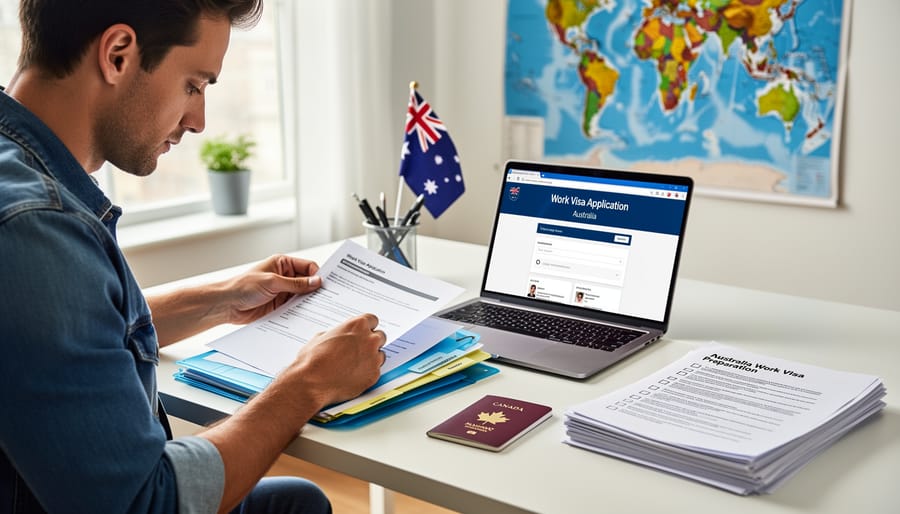
Before you begin the Australian work visa application, you’ll need several critical pieces in place, most importantly, a confirmed job offer from an Australian employer who is an approved sponsor or willing to become one. The employer’s role in this process cannot be overstated: they must nominate you for the position before you can submit your own visa application, making their participation and compliance essential to your success.
Your employer must either hold current sponsorship approval or be prepared to apply for it. Approved sponsors are businesses or organizations that have met specific obligations and been authorized by the Department of Home Affairs to nominate overseas workers. You can verify an employer’s sponsorship status through the Australian Government’s publicly available register of approved sponsors, or confirm that they understand the requirements and timeline involved in securing approval if they haven’t sponsored workers before.
Alongside the job offer, you’ll need to gather personal documentation that proves your identity, qualifications, and work history:
- Valid passport with sufficient validity beyond your intended stay
- Job offer letter from an approved sponsor detailing position, salary, and employment terms
- Educational qualifications and professional certifications relevant to the nominated occupation
- Evidence of work experience, such as employment references, contracts, and pay slips demonstrating your background in the field
- Skills assessment from the relevant assessing authority if your occupation requires one
- English language test results if your occupation or visa stream requires demonstrated proficiency
- Health examination results and police certificates for character assessment purposes
The skills assessment deserves particular attention. Certain occupations on Australia’s skilled occupation lists require you to have your qualifications and experience formally assessed by a designated authority before you can be nominated. Check whether your intended role requires this step, as obtaining the assessment can take several weeks and must be completed before your employer submits the nomination application.
Important Requirements and Restrictions to Know

Before you begin the application process, understand the critical eligibility requirements and potential roadblocks that could derail your Australian work visa journey. These aren’t minor administrative details, they’re mandatory conditions that determine whether you can even submit an application.
Employer Nomination is Non-Negotiable
You cannot apply for a 482 or 186 visa on your own initiative. Both pathways require nomination by an approved sponsor, an Australian employer who has official sponsorship status with the Department of Home Affairs. The employer must complete their nomination application first, demonstrating that the position is genuine and that they’ve met their sponsorship obligations. Only after their nomination is approved can you proceed with your personal visa application. This two-stage process means your timeline depends entirely on your employer’s participation and preparation.
The Two-Year Work Requirement for Permanent Transition
If you’re planning to transition from a temporary 482 visa to permanent residency through the 186 Temporary Residence Transition stream, you must work with the same employer for at least two years before you’re eligible. This requirement can’t be waived or shortened, so factor this timeline into your career planning.
Occupation and Skills Criteria
Your occupation must appear on Australia’s relevant skilled occupation lists, and certain roles require formal skills assessments from designated assessing authorities. Not every job qualifies for sponsorship, regardless of your experience level.
Health and Character Standards
All applicants must meet strict health and character requirements, including medical examinations and police certificates from every country you’ve lived in for 12 months or more during the past decade. Previous criminal convictions or serious health conditions can result in visa refusal.
Step-by-Step: How to Apply for an Australian Work Visa

Step 1: Secure a Job Offer from an Approved Sponsor
Your first step is landing a job with an Australian employer who can sponsor you. Not every Australian company can sponsor foreign workers, they must hold approved sponsor status with the Department of Home Affairs, or be willing to apply for it. Start by targeting larger organizations in your field, as they’re more likely to have existing sponsor approval and experience with the process.
Use international job boards, LinkedIn, and Australian employment sites to identify opportunities explicitly mentioning visa sponsorship or international candidates. When you find promising roles, research the company’s sponsorship history before applying. Many approved sponsors list this status on their careers pages or will confirm it during initial contact.
Networking matters enormously. Connect with Canadians already working in Australia, join professional groups in your industry, and attend virtual networking events focused on Australian employers. These connections can provide insider knowledge about which companies actively sponsor overseas workers and may refer you to hiring managers.
During interviews, ask directly about sponsorship: “Is your company an approved sponsor, and would you consider sponsoring the right candidate?” This shows you understand the process. After promising interviews, follow up professionally to demonstrate your genuine interest and commitment to relocating.
Be prepared to explain why you’re worth the investment, employer sponsorship involves costs and administrative effort, so you’ll need to show specialized skills or experience that justify the process.
Step 2: Employer Submits Nomination Application
Once you’ve accepted a job offer, your employer takes center stage by submitting a nomination application to the Australian Department of Home Affairs. This critical first stage must be completed and approved before you can apply for your own visa. Your employer needs to demonstrate that the position is genuine and necessary, providing detailed information about the role, salary, and why they’re filling it with a foreign worker rather than an Australian resident.
Depending on the visa type and occupation, your employer may need to show evidence of labor market testing, proving they advertised the position locally but couldn’t find suitable Australian candidates. They’ll also need to confirm their status as an approved sponsor and demonstrate compliance with sponsorship obligations, including paying market salary rates and maintaining workplace standards.
The nomination application involves substantial documentation from your employer’s side, including business details, position justification, and employment contract terms. Until the Department approves this nomination, you cannot proceed with your visa application. This means the timeline for your work visa depends partly on how quickly your employer completes their nomination and how efficiently the Department processes it. Stay in regular contact with your employer during this stage to ensure they have any additional information needed to support a successful nomination outcome.
Step 3: Prepare Your Visa Application
Once your employer’s nomination receives approval, it’s time to compile your personal documentation package. You’ll need your current passport (valid for at least six months beyond your intended stay), certified copies of all educational qualifications and professional certifications, detailed employment references covering your work history, and your skills assessment if your occupation requires one.
Health examinations are mandatory. Book appointments with panel physicians approved by the Department of Home Affairs, only examinations from these designated doctors will be accepted. You’ll also need police certificates from every country where you’ve lived for 12 months or more in the past 10 years, including Canada. Request these early, as obtaining them can take several weeks.
Organize everything methodically. Create clearly labeled digital folders matching the application requirements, with all documents scanned in color at high resolution. Save files as PDFs and keep originals accessible, you might need to present them later. For qualifications earned outside Australia, include official translations if they’re not in English.
Double-check that employment references are on company letterhead, signed by supervisors, and detail your specific duties and dates of employment. The Department scrutinizes these carefully to verify your claimed experience matches the nominated position’s requirements.
Step 4: Submit Your Visa Application
Once your employer’s nomination receives approval, you can proceed with your personal visa application through the Australian Government’s online system. Start by creating an ImmiAccount on the Department of Home Affairs website if you don’t already have one. This secure portal will be your hub for the entire application process.
Log into your ImmiAccount and select the appropriate visa subclass, either the 482 Temporary Skill Shortage or 186 Employer Nomination Scheme visa, depending on your pathway. The online form will guide you through several sections covering your personal details, employment history, qualifications, and travel history. Take your time completing each field accurately. Even minor errors can delay processing or lead to complications.
Upload all required documents in the specified formats. Most systems accept PDF files for documents like your passport, skills assessments, qualification certificates, employment references, health examination results, and police clearances. Ensure scans are clear and legible.
After reviewing your completed application thoroughly, you’ll proceed to payment. Application fees vary by visa type and are subject to change, so verify the current amounts on the official Department of Home Affairs website before submitting. Keep your payment receipt as confirmation. Once submitted, you’ll receive an acknowledgment through your ImmiAccount, and your application enters the assessment queue.
Step 5: Wait for Assessment and Decision
After you submit your visa application, the Department of Home Affairs begins reviewing your documents and verifying the information you’ve provided. This assessment phase involves checking that all required documents are complete, authentic, and meet current immigration standards. You’ll receive confirmation that your application has been received, and you can track its status through your ImmiAccount.
During the assessment, you may be contacted with requests for additional information or clarification. Respond promptly to any such requests, as delays in providing documents can slow your application. Some applicants will be asked to provide biometrics (fingerprints and photographs) at an Australian Visa Application Centre, while others may be required to attend an interview with immigration officials. These requirements vary based on individual circumstances and the visa stream you’ve applied for.
Processing times fluctuate depending on application volume, complexity of your case, and the specific visa stream. The Department doesn’t guarantee timeframes, so avoid making firm travel or employment plans until you receive a decision. When your application is finalized, you’ll be notified through your ImmiAccount. If approved, your visa grant letter will outline your visa conditions, work rights, and validity period. If refused, the notification will explain the reasons and your review options.
Choosing the Right Visa Stream for Your Situation
Your choice between temporary and permanent visa pathways depends on your career goals, employer relationship, and how quickly you want to secure permanent residency. Each route has distinct advantages and requirements that make it more suitable for different situations.
The 482 temporary visa offers a flexible starting point, particularly if you’re new to working with an Australian employer or want to experience Australian workplace culture before committing long-term. This pathway lets you work temporarily while building the relationship and work history needed for permanent residency later. It’s ideal if you’re exploring whether Australia is the right fit for you and your family, or if you haven’t yet met all requirements for immediate permanent residency.
The direct permanent 186 route, through its Direct Entry stream, suits experienced professionals who meet all qualification and skills requirements upfront and have secured an employer willing to sponsor permanent residency immediately. You bypass temporary status entirely, gaining all permanent resident benefits from day one, including freedom to change employers and access to Medicare.
Understanding the three 186 streams helps clarify your options. The Direct Entry stream requires you to meet skills and qualification standards without prior Australian work experience. The Temporary Residence Transition stream specifically requires that you have worked with the same employer for two years on a 482 visa before you can transition to permanent residency through this pathway. The Labour Agreement stream applies only if your employer has a formal labour agreement with the Australian government, which is relatively uncommon.
Most Canadians start with the 482 visa to establish their career in Australia, then transition through the TRT stream after meeting the two-year requirement. This staged approach reduces initial barriers while building toward permanent residency with a proven employer relationship.
After You Receive Your Visa: Next Steps
Once your visa is granted, the Department of Home Affairs will send a visa grant notice specifying your visa conditions, work rights, and validity period. Review this document carefully to understand any restrictions on your employment, travel permissions, and pathway options. If you’re on a temporary 482 visa, note the date you can become eligible for the Temporary Residence Transition stream after working with your sponsoring employer for two years. For permanent 186 visa holders, your grant notice confirms immediate residency status with full work rights across Australia.
Your immediate post-approval tasks include:
- Verify all details in your visa grant notice and confirm your visa conditions using VEVO (Visa Entitlement Verification Online)
- Arrange travel bookings and temporary accommodation for your arrival in Australia
- Notify your sponsoring employer of your planned arrival date and confirm your start date
- Apply for a Tax File Number through the Australian Taxation Office before you begin work
- Open an Australian bank account, which you can often initiate before arrival
- Research settlement services and cultural integration resources to ease your transition
Understanding the connection between work and immigration pathways helps you plan beyond your initial visa grant. If you hold a temporary visa, familiarize yourself with permanent residency requirements early so you can position yourself for transition when eligible. The Australian Government’s settlement services website provides practical resources covering healthcare enrollment, housing, education systems, and workplace culture to support your successful integration into Australian life.
Common Questions About Australian Work Visas for Canadians
Can I bring family members on my Australian work visa?
Yes, both the 482 and 186 visas allow you to include eligible family members (spouse or partner and dependent children) in your application. They can live, work, and study in Australia while your visa is valid.
Can I switch employers while on a 482 visa?
You can change employers, but the new employer must be an approved sponsor and nominate you for a new 482 visa. You cannot simply transfer your existing visa to another company.
What’s the difference between nomination and visa application?
The employer-sponsored route is a two-stage process: first, your employer submits a nomination application to approve the position and your suitability; only after nomination approval can you apply for the actual visa. Both stages must be completed successfully.
What if my visa application is refused?
If refused, you’ll receive a letter explaining the reasons. You may have options to address the issues and reapply, request a review of the decision, or explore alternative visa pathways. Professional immigration advice can help you understand your options.
Do I need a skills assessment for every occupation?
Not all occupations require skills assessments, but many do. The requirement depends on your nominated occupation and which visa stream you’re applying through. Check the relevant occupation list and visa requirements to determine if your role requires assessment.
How long does the entire process take?
Processing times vary significantly based on visa type, application completeness, and current processing volumes. The Department of Home Affairs updates processing timeframes regularly on their website, so check there for current estimates rather than relying on outdated information.
Understanding these practical aspects helps you plan realistically. Unlike a holiday work visa that typically offers short-term stays with limited conditions, employer-sponsored Australian work visas involve more complex requirements but provide substantial work rights and potential permanent residency pathways. Remember that visa conditions, particularly for the 482, specify which employer you can work for and what activities you can undertake, so review your grant notice carefully when it arrives.
Securing an Australian work visa as a Canadian requires employer sponsorship and thorough preparation, but the pathways are well-established and accessible. Whether you’re pursuing the temporary 482 visa to gain experience or aiming directly for permanent residency through the 186 streams, success starts with building strong employer connections and understanding the two-stage nomination and application process.
Begin your journey by targeting employers who are approved sponsors or willing to support your application. Always verify current visa requirements, fees, and processing details on the Australian Department of Home Affairs website, as immigration rules evolve regularly. For complex situations or if you’re navigating occupation-specific requirements, professional immigration advice can streamline your path and prevent costly mistakes.
As global employment mobility grows and remote work reshapes career possibilities, JobGo remains committed to supporting international job seekers exploring opportunities beyond Canada’s borders. Your Australian work adventure starts with the right preparation and the right employer partnership.